

Lotion is a common type of topical preparation used to moisturize, soften, condition, protect, or otherwise treat the skin. Its relatively fluid consistency allows it to spread across the skin more easily than thicker preparations such as creams and ointments.
Although many people associate lotion primarily with body moisturizers, the term covers a broad range of formulations. Lotions can be designed for cosmetic skin care, pharmaceutical applications, specialized skin treatments, and sun protection.
Sunscreen lotions represent one important category. These products are formulated to distribute UV-filtering ingredients across exposed skin and are intended to reduce exposure to ultraviolet radiation.
The properties of a lotion depend on its ingredients, vehicle, manufacturing process, intended application, and the characteristics the finished product is designed to provide.
What Is Lotion?
A lotion is a liquid or semi-liquid preparation intended for application to the skin. It usually has a consistency that allows it to be spread over relatively large areas without the heavy or greasy feel associated with some ointments.
The composition of a lotion can vary substantially. Some formulations are predominantly water-based, while others contain combinations of water, oils, alcohols, emulsifiers, polymers, and other ingredients.
In pharmaceutical and dermatological products, the vehicle is selected partly according to the body site and the purpose of the preparation. A lotion may be particularly convenient for areas where a light formulation is easier to distribute, including larger or hairy areas of skin.
Unlike the word “moisturizer,” which generally describes a product’s purpose, “lotion” primarily describes a type of topical formulation. A lotion may therefore be moisturizing, medicated, cosmetic, protective, or designed for another specific purpose.
Different Types of Lotion
There is no single formula that defines every lotion. Manufacturers can create products with substantially different compositions and physical properties.
Moisturizing Lotions
Moisturizing lotions are formulated to improve the hydration and feel of the skin. They commonly combine water with ingredients that soften the skin and reduce moisture loss.
These products are widely used after bathing, during dry weather, or whenever the skin feels rough or dry.
Medicated Lotions
Some lotions contain active ingredients intended to manage particular skin conditions or symptoms.
Depending on the product, active ingredients may be used for purposes such as reducing inflammation, controlling itching, treating certain infections, or addressing other dermatological problems.
Because medicated products can have specific instructions and precautions, they should be used according to their labeling or professional guidance.
Cosmetic Lotions
Cosmetic lotions are primarily intended to improve the appearance, texture, or feel of the skin.
They may contain moisturizers, fragrances, botanical ingredients, skin-conditioning agents, or other cosmetic components.
Sunscreen Lotions
Sunscreen lotions contain UV filters and are formulated to provide protection against ultraviolet radiation.
They can be produced as lightweight facial products, richer body formulations, water-resistant products, or combinations that provide both moisturization and sun protection.
Shake Lotions
Some lotions contain suspended particles that can settle during storage. These products need to be shaken before use so that the ingredients are redistributed throughout the preparation.
DermNet notes that some shake lotions separate over time and therefore need to be shaken back into suspension before application.
How Lotion Is Formulated
Creating a lotion involves more than combining a few ingredients. Formulators have to consider how the ingredients interact, how the product feels on the skin, how stable it remains during storage, and how easily it can be applied.
A typical formulation may contain a primary liquid phase together with oils, active ingredients, stabilizers, emulsifiers, preservatives, and other functional components.
The exact formulation depends on the product’s purpose.
Water-Based Formulations
Water is frequently used as a major component of topical preparations. It provides a vehicle for water-soluble ingredients and contributes to the fluid consistency associated with many lotions.
Oil and Water Systems
Some lotions contain both oil and water. Because these liquids do not naturally remain mixed, formulators use emulsifying systems to create a stable dispersion.
This type of formulation can combine the lightweight feel of a water-rich product with the conditioning properties of oil-based ingredients.
Suspensions
A suspension contains solid particles dispersed throughout a liquid.
Because particles can gradually settle, the product may need to be shaken before application. Suspension-based formulations can be useful when an ingredient cannot simply be dissolved in the liquid vehicle.
Emulsions
An emulsion contains two phases, commonly an aqueous phase and an oil phase, that have been combined using suitable emulsifying ingredients.
Many familiar skin-care lotions use emulsion technology because it allows formulators to incorporate both water-soluble and oil-soluble components.
Ingredients Commonly Used in Lotion
The ingredient list of a lotion depends on its intended purpose. A simple body moisturizer may have a relatively straightforward composition, while a medicated or sunscreen lotion may contain additional active ingredients.
Water
Water commonly serves as the main vehicle in many lotions.
It helps create the desired consistency and provides a medium for incorporating water-soluble components.
Emollients
Emollients are skin-conditioning ingredients that help make the skin feel softer and smoother.
They can include oils, esters, fatty materials, and other substances selected for their ability to improve the skin’s surface characteristics.
Humectants
Humectants help attract and retain water.
Glycerin is a widely used example. Other humectant ingredients may also be incorporated depending on the desired characteristics of the finished product.
Humectants are particularly common in formulations intended for dry or dehydrated-feeling skin.
Occlusive Ingredients
Occlusive substances help reduce water loss from the skin by forming a barrier or film over its surface.
Petrolatum is a well-known example of an occlusive ingredient. Certain oils, waxes, and other lipid-based substances can also contribute to this function.
Emulsifiers
When a lotion contains water and oil, an emulsifier or emulsifying system can help maintain the two phases in a stable mixture.
The choice of emulsifier affects the texture, stability, appearance, and performance of the final product.
Thickeners
Thickening agents are used to control viscosity.
A formulation that is too thin may be difficult to apply without running, while one that is too thick may no longer provide the light spreading characteristics expected from a lotion.
Preservatives
Water-containing topical products can be susceptible to microbial contamination. Appropriate preservation systems may therefore be used to help maintain product quality and safety during its intended shelf life.
The choice of preservative depends on the formulation, packaging, intended use, and applicable regulations.
Fragrance
Fragrance ingredients may be included to give a lotion a particular scent.
However, fragrance is not essential to the function of a lotion, and fragrance-free formulations are available for people who prefer them.
What Is Lotion Used For?
The versatility of lotion comes from the wide range of ingredients that can be incorporated into a topical vehicle.
Moisturizing
The most familiar use of lotion is probably moisturizing.
A combination of humectants, emollients, and occlusive ingredients can help improve the feel and hydration of dry skin.
Skin Softening
Lotion can make rough or dry skin feel smoother and more comfortable by conditioning the outer surface.
Cosmetic Skin Care
Many lotions are designed as everyday personal-care products. Their purposes can include moisturizing, improving skin feel, adding fragrance, or providing a particular cosmetic finish.
Pharmaceutical Applications
Topical medicines may also be formulated as lotions. The vehicle can influence how easily a preparation spreads and how the active ingredient is delivered to the skin.
DermNet explains that topical vehicles can be optimized according to the treatment site and the type of skin problem being addressed.
Sun Protection
When UV filters are incorporated into a lotion, the product can function as a sunscreen.
This allows the sunscreen ingredients to be spread over exposed areas of skin in a familiar lotion format.
What Is a Sunscreen Lotion?
A sunscreen lotion is a topical lotion containing ingredients intended to reduce the amount of ultraviolet radiation reaching the skin.
Ultraviolet radiation is invisible radiation from the sun and other sources. Excessive UV exposure can cause sunburn and contribute to long-term skin damage and skin cancer.
Sunscreen lotions are therefore different from ordinary moisturizing lotions because they contain UV-filtering ingredients and are specifically formulated and labeled for sun protection.
Some products combine sunscreen with moisturizing ingredients, allowing one product to provide both functions.
UVA and UVB Radiation
Solar UV radiation is commonly discussed in terms of UVA and UVB.
UVA
UVA radiation reaches deeper layers of the skin than UVB and contributes to cumulative skin damage and photoaging.
UVB
UVB is strongly associated with sunburn and also contributes to the development of skin cancer.
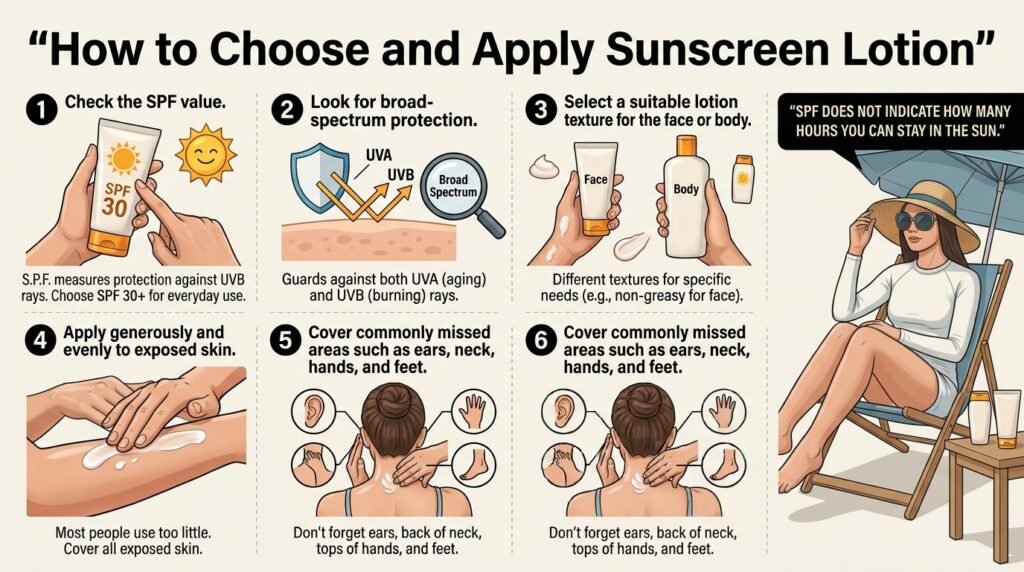
Because both types of UV radiation can damage the skin, broad-spectrum sunscreen is designed to provide protection against both UVA and UVB. The FDA’s labeling requirements use “broad spectrum” for sunscreens that meet its requirements for UVA and UVB protection.
Understanding SPF
SPF means Sun Protection Factor.
The SPF value primarily indicates the level of protection against UVB-related sunburn under standardized testing conditions. It should not be treated as a calculation of how many hours a person can safely stay outdoors.
Sunscreen also does not eliminate the need for other forms of sun protection.
The World Health Organization recommends combining sunscreen with measures such as shade and protective clothing, rather than using sunscreen to extend time spent in the sun.
Mineral and Organic UV Filters
Sunscreens can use different categories of UV-filtering ingredients.
Mineral Filters
Mineral sunscreen products commonly use zinc oxide or titanium dioxide.
These ingredients are widely used in sunscreen formulations and can contribute to broad-spectrum protection when appropriately formulated.
Organic Filters
Other sunscreen products use organic UV filters that absorb specific portions of ultraviolet radiation.
Modern sunscreen formulations may contain several UV filters so that the product provides the desired range and level of protection.
Some products combine mineral and organic filters in the same formulation.
Broad-Spectrum Sunscreen
A broad-spectrum sunscreen is designed to protect against both UVA and UVB radiation.
This distinction is important because SPF alone does not describe the entire range of UV protection.
When selecting sunscreen, consumers can therefore consider both the SPF value and whether the product is labeled as broad spectrum.
The FDA specifically distinguishes broad-spectrum products from sunscreens that do not meet its broad-spectrum requirements.
Water-Resistant Sunscreen Lotion
Some sunscreen lotions are labeled as water resistant.
Water resistance does not mean that sunscreen remains permanently on the skin after swimming or sweating.
In the United States, water-resistance claims are associated with specified periods, such as 40 or 80 minutes, under testing conditions. Products should be reapplied according to their labeling, particularly after swimming or sweating. FDA guidance also states that sunscreen products should not be described as “waterproof” or “sweat proof.”
Lotion, Cream, and Ointment: What Is the Difference?
These terms generally refer to different types of topical vehicles.
Lotion: Usually more fluid and easier to spread across large areas.
Cream: Generally thicker and often formulated as an oil-and-water emulsion.
Ointment: Usually much more occlusive and oil-rich, producing a heavier and greasier layer on the skin.
The choice between them depends on factors such as the treatment area, skin condition, desired texture, and intended effect. DermNet notes that manufacturers can use these terms somewhat differently, meaning that products with similar characteristics may sometimes receive different names.
Lotion for Different Skin Types
There is no single lotion that is ideal for every skin type.
Dry Skin
A richer moisturizing formulation containing humectants, emollients, and occlusive ingredients may be useful for dry skin.
Oily Skin
People with oily skin may prefer lighter lotions that spread easily without leaving a heavy or greasy residue.
Combination Skin
A balanced, lightweight moisturizer can provide hydration without feeling excessively rich.
Sensitive Skin
People with sensitive skin may prefer simpler formulations and may choose products without added fragrance or other ingredients they know cause irritation.
Individual reactions vary, so ingredient selection should take personal tolerance into account.
Face Lotion vs. Body Lotion
Facial and body lotions are not necessarily formulated in the same way.
Facial products may be designed around different cosmetic requirements, such as lighter textures, compatibility with makeup, or reduced greasiness.
Body lotions are often designed to spread efficiently over larger areas and may have richer textures.
The distinction becomes particularly relevant with sunscreen because facial sunscreens may be formulated to leave a different finish than products intended for the arms, legs, or torso.
How to Apply Sunscreen Lotion
Proper application is important because uneven or insufficient coverage can reduce the protection provided by sunscreen.
A practical approach is to:
- Apply sunscreen generously to exposed skin.
- Spread it evenly across the areas that will be exposed.
- Cover commonly missed areas such as the ears, neck, nose, and tops of the feet.
- Follow the product’s instructions regarding when to apply it before sun exposure.
- Reapply as directed, particularly after swimming, sweating, or toweling.
- Use shade, clothing, and other protective measures when appropriate.
WHO recommends broad-spectrum sunscreen for exposed skin that cannot be adequately protected by clothing, while emphasizing shade and protective clothing as important components of sun protection.
How Much Sunscreen Should Be Applied?
Using too little sunscreen can result in substantially less protection than the SPF shown on the label.
WHO guidance notes that approximately 35 mL of sunscreen is needed to cover the entire body of an adult at the amount used for the quoted SPF in its guidance.
The precise amount used in practice can vary according to the body size and the areas exposed. The important point is that sunscreen should be applied generously and evenly rather than as a very thin layer.
Sunscreen for Children
Children and adolescents are particularly vulnerable to the harmful effects of excessive UV exposure, making sun protection important during outdoor activities.
Protection can include:
- Shade
- Protective clothing
- Hats
- Sunglasses that provide appropriate UV protection
- Sunscreen on exposed skin when appropriate
Parents and caregivers should follow the age restrictions, directions, and warnings on the specific sunscreen product.
For very young children, additional precautions may be particularly important because sunscreen is not a substitute for keeping infants out of direct sunlight.
Can Lotion Expire?
Lotion can change over time, particularly when exposed to unsuitable storage conditions.
Heat, excessive sunlight, moisture, contamination, and prolonged storage can affect the physical characteristics of a product.
Consumers should follow the manufacturer’s storage instructions and pay attention to expiration information where provided.
A lotion that has developed an unusual odor, separated unexpectedly, changed color, or developed a substantially different texture should be evaluated according to the manufacturer’s guidance rather than assumed to be unchanged.
Can Lotion Irritate the Skin?
Yes. Some people can experience irritation or allergic reactions to ingredients in topical products.
Potential triggers can include fragrance ingredients, preservatives, active ingredients, botanical components, or other formulation ingredients.
If a lotion repeatedly causes burning, redness, itching, swelling, or another concerning reaction, discontinuing the product and seeking appropriate medical advice may be necessary.
People with known sensitivities should check the ingredient list before purchasing or applying a new product.
How to Select a Lotion
Choosing a lotion is easier when the intended purpose is considered first.
Important factors can include:
- Skin type
- Dryness level
- Intended application area
- Desired texture
- Moisturizing ingredients
- Fragrance preferences
- Known sensitivities
- Whether an active ingredient is required
- Whether UV protection is needed
- SPF level for sunscreen products
- Broad-spectrum labeling
- Water-resistance requirements
- Product directions and warnings
For everyday moisturizing, the focus may be on the formulation and skin feel. For outdoor use, sunscreen labeling and the product’s UV-protection characteristics become much more important.
Frequently Asked Questions About Lotion
What is the main purpose of lotion?
Lotion can be used for moisturizing, skin conditioning, cosmetic care, pharmaceutical treatment, or sun protection depending on its formulation.
Is lotion better than cream?
Neither is universally better. Lotions are generally lighter and easier to spread, while creams are usually thicker and may provide a richer feel.
Can regular lotion protect against the sun?
Only if the product has been specifically formulated and labeled as a sunscreen. A normal moisturizer should not be assumed to provide meaningful UV protection.
Is sunscreen lotion the same as moisturizer?
Not necessarily. A sunscreen lotion contains UV filters intended for sun protection. Some sunscreen lotions also contain moisturizing ingredients, but their primary additional function is UV protection.
Does SPF tell me how long I can stay outside?
No. SPF is not a number of hours of safe sun exposure. Sunscreen should be combined with shade, clothing, and other protective measures.
Is mineral sunscreen safer than other sunscreen?
Mineral and organic sunscreen formulations use different types of UV filters. The appropriate choice depends on the product, its labeling, the intended use, and individual preferences or sensitivities.
Does water-resistant sunscreen need to be reapplied?
Yes. Water-resistant sunscreen can be removed by swimming, sweating, and toweling. Follow the product’s reapplication instructions. FDA guidance recognizes specific 40- or 80-minute water-resistance claims rather than treating sunscreen as waterproof.
Can sunscreen replace other sun-protection methods?
No. Sunscreen is one part of sun protection. WHO recommends combining sunscreen with shade, protective clothing, hats, and other measures, particularly when UV levels are high.
Conclusion
Lotion is a flexible topical format capable of delivering moisturizing agents, skin-conditioning ingredients, cosmetic components, medicines, and UV filters.
Its final characteristics depend on the vehicle and the combination of ingredients used. Water, oils, humectants, emollients, occlusives, emulsifiers, thickeners, preservatives, fragrances, and active ingredients can all play different roles within a formulation.
Sunscreen lotions extend this concept by incorporating UV filters that help reduce exposure to ultraviolet radiation. Understanding the distinction between UVA and UVB, the meaning of SPF, broad-spectrum labeling, water resistance, and correct application can make sunscreen use more effective.
Ultimately, selecting a lotion should begin with its intended purpose. A lightweight moisturizer may be appropriate for everyday skin conditioning, while a specialized formulation may be preferable for a particular skin concern or for outdoor sun protection.
References
- U.S. Food and Drug Administration (FDA). Tips to Stay Safe in the Sun: From Sunscreen to Sunglasses. FDA Consumer Updates.
- World Health Organization (WHO). Ultraviolet radiation. WHO Fact Sheet, 21 June 2022.
- World Health Organization (WHO). Radiation: Protecting against skin cancer. WHO Questions and Answers, 16 July 2024.
- DermNet. Topical formulations. Information on topical vehicles, lotions, creams, ointments, suspensions, emulsions, and formulation considerations.
- World Health Organization (WHO). Radiation: The ultraviolet (UV) index. WHO Questions and Answers.
- International Agency for Research on Cancer (IARC). Solar and Ultraviolet Radiation. IARC Monographs on the Evaluation of Carcinogenic Risks to Humans.