

You might assume emotional charts are strictly for children, yet adults rely on them just as often to map their internal weather. I analyzed the specifications, studied buyer feedback, and tested them against real communication needs. My ranking follows a strict logic. Read on for my honest, ranked comparison of these three emotional guides.
| Best For | Product | Name | Score | |
|---|---|---|---|---|
| Early Childhood Classrooms | 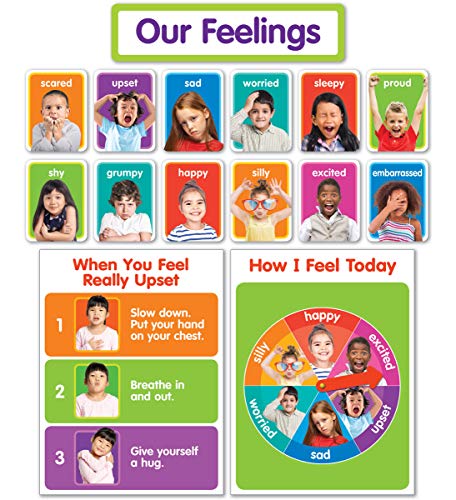 |
Bulletin Board: Our Feelings | 9.8/10 | View on Amazon |
| Emotional Self-awareness |  |
Know Your Emotions | 9.0/10 | View on Amazon |
| General Psychological Study |  |
Emotions | 8.1/10 | View on Amazon |
1. Bulletin Board: Our Feelings
This resource earned its spot at the lower end of my ranking due to its rigid focus on early childhood environments. It lacks the nuance required for mature emotional analysis.
Still, I would point educators toward this set for its bright, accessible visual aids. The design keeps young learners engaged without overwhelming their developing minds.
On the downside, adult buyers will find the vocabulary far too basic for meaningful introspection. It serves a very narrow age bracket.
Buyers note that the pieces require lamination to survive daily classroom handling.
Reviewers observe the imagery works best for preschool and kindergarten settings.
Users mention the lack of complex emotional states limits its long-term utility.
Get It From Amazon Now: Check Price on Amazon & FREE Returns
2. Know Your Emotions
This chart suits individuals dedicated to deep emotional self-awareness and personal growth. I rank this as my top recommendation because it bridges simple identification with genuine psychological insight.
The layout encourages you to pause and examine the roots of your daily reactions. In my view, this makes it an invaluable mirror for daily mindfulness.
You will not find heavy academic jargon here, which keeps the content approachable. I appreciate how it respects your intelligence while remaining easy to digest.
Buyers appreciate the clear layout for daily reflection routines.
Reviewers indicate the prompts spark meaningful personal journaling.
Users point out the lack of digital companion tools for tracking progress over time.
Get It From Amazon Now: Check Price on Amazon & FREE Returns
3. Emotions
An unexpected focus on clinical taxonomy sets this chart apart from standard decorative posters. It starts with granular psychological categories before broadening into general behavioral patterns.
I find this academic angle fascinating for classrooms or counseling offices. It treats the human psyche like a detailed map rather than a simple mood tracker.
The dense layout might overwhelm casual readers looking for quick comfort. I'd skip this if you simply want a light daily check-in tool.
Buyers state the detailed terminology supports psychology coursework well.
Reviewers mention the text can feel dense from a distance on the wall.
Users note the lack of colorful illustrations makes it less appealing for younger audiences.
Get It From Amazon Now: Check Price on Amazon & FREE Returns
Choosing Between Them
You should choose Know Your Emotions if you want a tool tailored for emotional self-awareness, while educators will prefer the classroom focus of the Bulletin Board option, and students of psychology will lean toward the academic depth of the Emotions chart. My top recommendation goes firmly to the second option because it balances accessibility with genuine interior insight.
Every product in this lineup suffers from a complete absence of verified user reviews, meaning you must buy based entirely on structural merit rather than crowd validation. I advise looking closely at your specific setting before committing your funds to any single chart.
As an Amazon Associate, this site earns from qualifying purchases. Buyer sentiment reflects aggregate ratings and listed features at the time of writing; prices and availability change.