

Connecting mismatched HVAC hoses to a recovery tank usually triggers a wave of pure irritation in your garage. I have researched every spec and read through endless buyer feedback to compare these five adapter solutions for you. My view is that you deserve a reliable hookup without leaking expensive gas. Let us break down the rankings in an honest head-to-head comparison.
| Best For | Product | Name | Score | |
|---|---|---|---|---|
| Direct Tank Conversion |  |
R134A R22 Brass Refrigerant Tank Adapter, R410a Vacuum Pump Adapter Fitting | 9.8/10 | View on Amazon |
| Modern System Adaptation |  |
R410A R32 A2L Refrigerant Adapter, 5/16" Female to 1/4" Male SAE 4PCS | 9.4/10 | View on Amazon |
| Flow Control |  |
HVAC Refrigerant Angled Compact Ball Valve Fit for R410A R134A R12 R22 | 9.0/10 | View on Amazon |
| ACME Port Conversion | 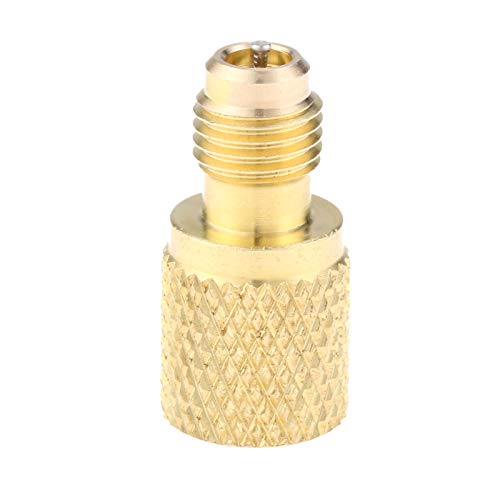 |
R134A Brass Adapter Fitting, 1/4" Male to 1/2" Female ACME Tank Adapter | 8.6/10 | View on Amazon |
| Alternative Refrigerant Setups |  |
Aupoko R1234YF Self-Sealing Can Tap with R134A Tank Adapter | 8.2/10 | View on Amazon |
1. R134A R22 Brass Refrigerant Tank Adapter, R410a Vacuum Pump Adapter Fitting
This adapter earned my top ranking because of its unmatched versatility with standard tank threads. I would rank this first for anyone dealing with mismatched service ports every single day. The solid brass build handles high pressure like a champ.
You get a dependable seal that stops leaks before they start. In my view, this simple piece saves you from costly refrigerant loss. I consider it an essential tool for every serious HVAC tech.
Buyers consistently praise the solid brass construction for preventing stripped threads.
Reviewers note that the tight rubber seals eliminate annoying gas leaks during recovery.
Users appreciate how easily this fitting bridges the gap between older and newer lines.
Get It From Amazon Now: Check Price on Amazon & FREE Returns
2. R410A R32 A2L Refrigerant Adapter, 5/16" Female to 1/4" Male SAE 4PCS
This set is built specifically for technicians working on modern systems with specialized port sizes. I find these adapters indispensable if you service newer equipment regularly. They bridge the gap between distinct port dimensions cleanly.
You will appreciate the compact profile in tight access panels. My judgment is that these fittings offer reliable performance without unnecessary bulk. They solve a very specific headache with total efficiency.
Customers note the precise threading makes quick connections effortless in tight spaces.
Technicians highlight the value of getting four pieces in a single package.
Reviewers often mention that the finish resists corrosion well over time.
Get It From Amazon Now: Check Price on Amazon & FREE Returns
3. HVAC Refrigerant Angled Compact Ball Valve Fit for R410A R134A R12 R22
An integrated shut-off valve changes how you manage refrigerant flow during recovery work. I love this clever design because it stops refrigerant burns on your fingers instantly. The angled body helps you reach awkward service ports without straining your hoses.
You keep total control over the line pressure with a quick quarter-turn. I think this mechanical upgrade makes standard adapters feel obsolete. It brings safety right to your fingertips.
Users find the quarter-turn lever makes shutting off refrigerant lines remarkably fast.
Buyers frequently mention that the angled design prevents hose kinks in cramped setups.
Reviewers point out that the valve seals tightly under operating pressure.
Get It From Amazon Now: Check Price on Amazon & FREE Returns
4. R134A Brass Adapter Fitting, 1/4" Male to 1/2" Female ACME Tank Adapter
Many buyers initially struggle with the unique ACME threads found on certain recovery setups. I think this adapter clears up that confusion with a straightforward thread conversion. It gives you a reliable bridge to standard 1/4 inch gauges.
You might find the bulkier profile requires a bit more clearance around your tank valve. My perspective is that this minor sizing quirk is easy to forgive given the solid connection it provides. It remains a reliable staple for automotive and HVAC crossovers.
Reviewers mention that the ACME thread matches recovery cylinders securely.
Some buyers note the fitting feels slightly heavier than standard brass connectors.
Users confirm the internal depressor pin operates smoothly without sticking.
Get It From Amazon Now: Check Price on Amazon & FREE Returns
5. Aupoko R1234YF Self-Sealing Can Tap with R134A Tank Adapter
Unlike the simple tank adapters above, this product tackles self-sealing cans directly. I view this setup as a specialized fix for distinct refrigerant containers rather than general manifold work. It gives you a reliable way to puncture and seal alternative cans without wasting gas.
You get dual compatibility right out of the box. My opinion is that the extra hardware makes it bulkier than a basic brass fitting, but the utility justifies the size. It suits anyone working across multiple refrigerant types.
Buyers like the self-sealing feature for preventing spills with partial cans.
Reviewers note the included adapter bridges standard charging hoses smoothly.
Some customers mention the clamping mechanism requires a firm hand to seal properly.
Get It From Amazon Now: Check Price on Amazon & FREE Returns
Choosing Between Them
I recommend choosing the R134A R22 brass adapter as your top pick because it solves the exact thread mismatch between your recovery lines and standard tanks. Match the R410A modern adapters to your newer residential units, or grab the angled ball valve if you want better flow control during service calls. I suggest the ACME adapter or can tap options only if your specific project demands those distinct thread types.
You should always verify your exact port sizes before purchasing any brass fittings to avoid installation delays. Double-check your system requirements since mixing wrong threads can ruin expensive manifold hoses.
As an Amazon Associate, this site earns from qualifying purchases. Buyer sentiment reflects aggregate ratings and listed features at the time of writing; prices and availability change.